Walking in the light in the dark

I feel a little reluctant to post sermons, as I know that not all my readers share my faith in Christ. However, someone has kindly encouraged me to share more, so here’s one for Advent Sunday. I guess you don’t have to read on, but if you’d like to…

Isaiah 2.1-5 – Advent Sunday

These are dark days. There are so many causes for concern in the world, so many big problems that just seem intractable. In my own field of Christian engagement with environmental issues, the outlook seems very bleak.

Do I need to go into details? It’s really too depressing.

In these dark days we begin Advent.

In our culture, Advent is just about getting ready for Christmas, and for many it seems to be the start of Christmas. In the church, it’s traditionally been a time for entering into the darkness of a suffering world and experiencing, in the darkness, the long waiting for the light and salvation of God to come. That’s why we have readings today encouraging us to stay alert and awake – to make ourselves ready for the day of God’s coming and to live as people of light. I think the idea is to give us hope in our waiting.

Isaiah presents a vision to a people experiencing darkness, exile, the end of their nation, perhaps the end of their story. The remnant of Israel needed hope. The few that were left after years and years of invasion, siege, captivity and paying tribute to foreign empires, needed hope. They’d had years of having to defend their land and their crops against invaders. Years of sending their sons into battle armed with tools from the farm – boys carrying ploughshares and pruning hooks beaten into crude swords and spears. They’d had years of it and they needed change and they needed hope that things would change.

The world has had centuries of this – of oppression and injustice, of war and slaughter, of destruction of crops and land and livelihoods and homes – of tribe lifting up sword against tribe, of the powerful beating down the poor and taking what little they have – and we need change and in these dark days we need hope.

So here’s Isaiah’s vision – see if it makes you feel hopeful. The temple of God will be raised up and all nations will stream into it, looking to learn God’s way of living. That way will be a way of peace between all nations. There will be no more war.

Does it make you feel hopeful? To me, it seems naïve, idealistic. The evidence runs against this vision coming true. But I don’t want to let go of it, because it is a great vision – a vision worth holding on to, aspiring to, hoping for.

Whether it’s hopeful or not might depend on what you think prophecy is and does. There’s a view of prophecy that sees a passage like this as simple fore-telling. This is what the future will be like – it’s God’s plan and God will bring it about, because what God says will happen, will happen. All you have to do is wait for the prophecy to come true.

That doesn’t quite ring true for me, I’m afraid – and I’m sorry if that seems heretical. Bear with me for a minute. I can’t look at the state of the world and believe that God always gets what God wants. If God is not getting what God wants now, especially in relation to people I love & people I’m praying for, why should I think one day the world will be how God wants it, if it’s simply about God making it so. If then, why not now, for the sake of suffering people and a suffering world? If God can do it in the future, why not do it now?

So I’m more inclined towards a view of prophecy that sees people like Isaiah imagining (Holy-Spirit-inspired if you like) what God’s will might look like. By putting this vision into words, it helps bring it into being, but a response is also needed from hearers and readers. The prophecy can only come true when, in the words of this prophetic passage, people say, “Come, let us walk in the light of the Eternal” – when they make that choice to align their lives with the words of the prophecy and invite the word of God to be made flesh in their lives.

This passage talks about people saying to each other, “Come”. It uses the language of learning and walking. It involves action in response: as people submit to the judgement of God rather than their own greed and anxiety; as they beat their tools of killing and war back into tools of growing food for life; and as people learn the ways of God, rather than learning better ways of killing each other.

It’s a prophecy that calls for response and for action. And as people choose to make this vision their vision for life, the prophecy comes true.

So every act of love becomes a fulfilment of prophecy. Every act of compassion becomes a fulfilment of prophecy. Every act of thoughtful care for creation. Every act of standing up to injustice. Every act of peace-making. Every act – however small – that is aligned with the word of God, that is aligned with the compassion of God for every person and every creature in all creation – becomes a building block of the kingdom of God.

I am sure this is how Jesus lived and how he saw himself fulfilling prophecy. I don’t think Jesus was a fatalist – he was inspired by the scriptures and chose for them to be fulfilled in him. He knew he had to say ‘Yes’ to God’s will in order for it to come into being. He knew how costly that would be for him, but he chose to walk in the light of the Lord, to be filled with the Holy Spirit, and to live out the deep and powerful compassion of God for a broken creation.

But this is not simply a message of human determination and effort, which is just as well, for me at least, because I know that I fall short of these ideals over and over again. I need God. Even Jesus needed God. He lived and acted in trust and dependence on the power of the Holy Spirit – in Jesus we see the union of God and humanity in its fullest possible manifestation.

It’s in the reading, too. It’s not about God making things happen, and it’s not about people making things happen. It’s about a union of lives – of the life of God and the lives of people. It is God who teaches the way of peace, but the people have to learn it. It is God who arbitrates between people, but the people have to beat their weapons back into farm tools. It is God’s light, but the people need to walk in it.

It would be easy to despair and feel there’s nothing you can do in the face of the problems in the world, and to feel that you’ll have to wait forever for God to do anything about them. But this reading gives us hope, because it assures us that a new world is possible. It assures us that God’s will is to bring peace to the world and to bring that new world into being. It shows us that when we respond to God’s word and align our will with God’s will and welcome the light of God into our lives, we can learn to walk in God’s way and be part of the coming of this new world of peace.

Every act of love and positivity that is the result of us walking in the light of God – however small those acts may be – means that we are doing something and God is doing something, and so something can be done, and a new world breaks into the present world like a shaft of light through storm clouds. There is hope, however dark it gets.

So, for Jesus’ sake, that his words and actions might come to fulfilment in a world where all creation is made new and all creation lives together in peace – Come! Let us walk in the light of God.



Money makes the world go round?

As Extinction Rebellion turns its attention to financial institutions this week, I’ve posted a sermon about money from a few weeks ago.

Jesus had a lot to say about money and power. It’s not always easy to hear it and can be even harder to put it into practice in a culture that’s been based around the steady movement of wealth from poor to rich – a culture of debt recently (relatively speaking) enhanced by an environmental debt incurred through the burning of fossil fuels.

You can read the sermon here (or use the menu to find “The Dishonest Manager” under “Bible Studies”). Find out more here about Operation Noah’s Bright Now campaign to persuade churches to line up their finances with their faith.

Out-fox the fox

There’s a family of foxes in our neighbourhood. I suspect they live next-door, where the garden is more of a junk-yard (or as he’s an artist, he’d probably say ‘store of useful objects’). Foxes have been regular visitors to our garden but their activity has really stepped up this year, possibly because there are cubs. I posted a photo of one of the cubs on Facebook and provoked a range of comments, for and against foxes.

Foxy

I like seeing the foxes in the garden. I see little enough wildlife in my urban existence, so it’s a treat when there’s a fox sniffing around or some cubs playing.

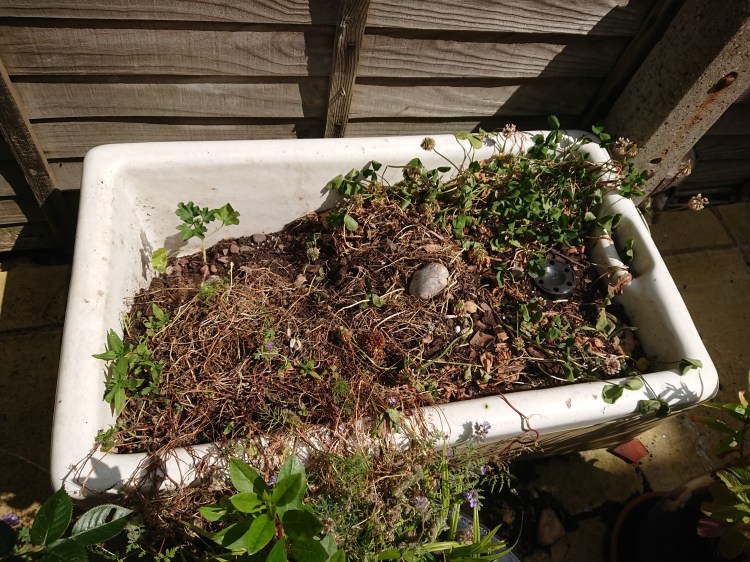
However… It’s not a treat to have to keep picking up the dog-food wrappers they leave behind, presumably brought through from a neighbour’s badly-secured bin. It’s also not a treat to have to keep filling in the holes they dig around the roots of shrubs. Worse still is the way they dig up my pots. I had planted clover and phacelia in this old sink, with a few dwarf sunflowers, giving it a fallow year – a break from tomatoes. The foxes keep digging it up, scattering the plants and the compost. I (and the plants) can’t keep up with them, so it’s just a mess.

Belfast sink

I keep the back end of the garden wild for wildlife. The grass grows long. The weeds go unweeded. The leaves are left. There’s hawthorn and hazel, rowan and laurel. There are a couple of log piles. The foxes would be welcome to dig there, but not in my pots on the patio. One of the Facebook comments said, How is a fox supposed to know not to dig there? Fair enough. But is it wrong to feel that it’s OK for me to exert some control over my garden?

wild side

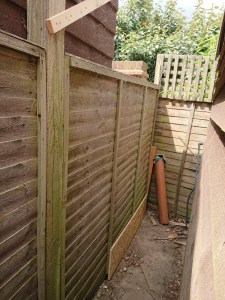
I think I know where the foxes were getting in: through a damaged fence panel behind the shed. I’ve blocked off the holes (leaving a little hole for hedgehogs – don’t worry) and added some chicken wire above the fence too. It’s too early to tell if it’s worked or not. I suspect nothing will keep them out, but in making access less easy I may restore some balance to the situation.

View behind shed

It’s balance that I’m concerned about. I’m happy for the foxes to come in and do a bit of digging for worms, and I can deal with the occasional food wrapper and the occasional lump of scat. But it was overwhelming. In the same way, I’ve taken measures to keep the squirrels off the bird feeder: I like seeing squirrels in the garden, but they were eating all the bird food and I want to support the birds.

I’m working on a very small scale here in a small garden. I feel that if I didn’t take steps to impose some control over the garden eco-system, it would soon get out of balance. Perhaps on a bigger scale, I could be more laid back and nature would find its own balance. I worry that my decisions about control are just based on my wish to have a nice garden. Even though, for me, a nice garden means a wildlife-friendly garden, I also want it to provide some food for me and my family and a pleasant environment for relaxation. I’m sure I’m making mistakes, because I know I don’t have the full picture of the complexity of the garden eco-system in my mind. But I want to do the right thing for the plants and animals of the garden, including the human animals.

There’s an obvious parallel with the way that human activity has become way out of balance with the rest of nature, overwhelming the global eco-system in so many ways. What we should have been doing, biblically-speaking at least, was caring for the earth in such a way that balance was maintained for the benefit of every creature – using our power for the common good. Perhaps the least I can do is become better informed about the wildlife in the garden and pay better attention to it – attention that is less judgemental, less self-centred and more loving, more humble, and more servant-hearted. The parallel coming back at me feels just as obvious.

By the people, for the people

Frack protestorsYesterday these three men were jailed for protesting against fracking in Lancashire. They had climbed onto trucks carrying drilling equipment and so prevented them from moving. The men were charged with causing a public nuisance. Simon Roscoe Blevins and Richard Roberts were jailed for 16 months, Richard Loizou for 15, and a fourth man, Julian Brock, was given a 12-month suspended sentence. In sentencing them, the judge said that he believed they were not rehabilitated inasmuch as they remained convinced of the rightness of their cause and that only a custodial sentence could punish them.
Lancashire County Council had refused planning permission for fracking at this site, but the UK government over-ruled the local authority. There is talk of making fracking exempt from planning permission, but the Lancashire case shows that local democracy counts for little anyway. So not only is the democratic channel of protest demolished, but in applying anti-terrorism and other laws to what in the past would have been regarded as peaceful, non-violent direct action and imprisoning those who protest, the government has illegitimated all opposition.

What will never happen is the oil and gas companies, or their political friends, being charged under public nuisance laws for the nuisance their drilling activities will cause to local people, which is likely to be far greater than a country road being closed for a couple of days. Neither will they ever be imprisoned for the criminal damage that burning their products causes to people, animals and plants all over the world, with the poorest and most vulnerable being the first and worst affected.

Biblically, rulers have a duty to protect the poorest and most vulnerable. Psalm 72, praying for the king, says, “May he defend the cause of the poor of the people, give deliverance to the needy, and crush the oppressor.” (Psalm 72.4). When governments defend the cause of big business and crush the poor, they act contrary to the will of God. When governments put money-making before caring for the vulnerable, and at great cost to the vulnerable, they act contrary to the will of God. Jesus said, “You cannot serve God and money.” (Matthew 6.24).

But… When governments choose money over God, are they simply reflecting a democratic mandate in the sense that choosing money over God is a daily choice many of us make? Jesus also said, “The rulers of the nations lord it over them and their great ones are tyrants over them. It will not be so among you…” (Matthew 20.25-26). If I want to say that my government, in delegitimising opposition and promoting economic growth through developing a domestic oil and gas industry whose products we should not use if we want to check climate change and keep the earth habitable for humans and many other species – if I want to say that they are not acting in my name, I need to make sure that I am choosing God over money, choosing servanthood over power, and doing what I can to defend the cause of the poor against the oppressor. I have much to learn, and there’s no time to lose.


Earthship

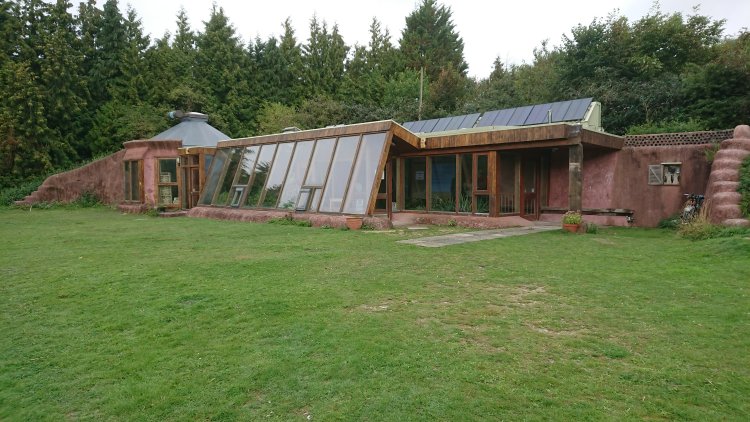
Today I went on a fascinating tour of Brighton’s Earthship.

In the words of pioneer Michael Reynolds, Earthships are “Buildings that sail on the seas of tomorrow.” In more mundane language, an Earthship is a building made of a mixture of waste, recycled and natural materials that is autonomous in terms of heating, cooling, power, water and sewage. The Brighton Earthship was built as an educational and community resource rather than a home. The walls are made of old tyres packed with sand and earth, apart from the south-facing wall of glass. Rainwater is harvested from the roof for all water needs. Thermal solar panels heat the water and photo-voltaic panels generate electricity, with the help of a small wind turbine and battery storage. There’s a wood-burning stove in the main room for extra heat in winter. Waste water is filtered through two internal plant beds and then into a reed bed outside, and there’s a compost toilet in the garden.

It’s certainly a funky place. I love the flowing lines of the building, the way it sits back into the hillside and the idea of building from waste and being off-grid. But the big eye-opener for me was how something that could come across as idealistic is far from being so.

Mischa, who showed us around (and I hope I am not mis-representing him – my memory is full of holes like a Swiss cheese these days), was very open about some of the draw-backs, for example, the equipment needed to make the rain-water safe to drink, and the limitations of off-grid power. They use a gas cooker (bottled gas) because to cook with electricity would require a much beefier power system. They looked into the possibility of hooking up to mains electricity and it was the price that put them off. Mischa’s point was that location is a major factor: if you’re near a mains water supply, for example, it’s probably better to use that than buy, maintain and power the equipment to deal with rain-water. Very early on in his presentation, Mischa said that this approach to buildings wouldn’t work in a densely-populated urban context, although some of the ideas could – and should – be applied.

It all brings me back to a recent blog post about how complicated ethical living can be. Sometimes going straight for the sexy eco-tech solution might be more harmful than a more conventional option. On the bus back to the office, I read an article about plastic in the latest edition of ‘Clean Slate’ magazine from the Centre for Alternative Technology. In the article, Judith Thornton explains how plastic wrapping of food saves carbon emissions, because food keeps longer and less is wasted. For example, a shrink-wrapped cucumber lasts about four times as long as a loose one. The carbon footprint of uneaten food is estimated to be equivalent to 3.3 Giga-tonnes of CO2 – which, if it were a country, would make food waste the third largest emitter after the USA and China. Of course, you can reduce the supply chain by buying local food from a farmers market, in which case the supplier doesn’t need to wrap it in plastic (though you may need to at home – but it can be re-usable).

I think it’s important that places like the Brighton Earthship exist and demonstrate low-impact alternatives to mainstream ways of living. My take-away from the morning was that there’s a cost to everything, and being thoughtful and informed is more important for making good choices than just blindly following a campaign, and that all the (necessarily) focussed environmental campaigners need to avoid fundamentalist thinking but talk to each other so that we can see the big picture and tell a big story that will help us all sail on the seas of tomorrow.

Giving up

Four years ago, I bought a five-string banjo. I had discovered the joy of bluegrass music and loved the sound of the banjo in it. I’ve been playing the guitar most of my life and finger-pick quite a lot, so I thought, How hard could it be to learn the banjo?

dsc_00118577056650445278454.jpg

I started with some tutor videos on Youtube and practised a couple of rolls. I quickly realised that playing bluegrass banjo is very hard, with its pesky chanter string that’s high-pitched but positioned below the bottom string, and with the way the thumb tends to carry the tune, but still, I made a little progress. Then we moved house and I no longer had the space to have the banjo out, so it sat, neglected, in its case. In new year 2017 I resolved to give it another go (and went public with a blog post). I bought a tutor book written by Earl Scruggs himself, and tried practising a little every day. I did quite well and learned to play Cripple Creek by mid-February. The next section involved a lot of technical stuff, with roll after roll, and I hit that wall you hit in learning anything new, when it seems like you’re not progressing and it’s just too hard. I needed to have lessons but I couldn’t afford them and I didn’t think I was nearly good enough to start playing with others (whoever they might have been).

So the banjo stayed in its case. This summer, I decided that I was never going to play bluegrass banjo and it was just cluttering up the dining room, so I put it up for sale on Gumtree. No one was interested in the ad, so at Brighthelm Camp I offered it to anyone who wanted it, in exchange for a donation to our local hospice, and it was snapped up straight away.

Part of me felt bad about giving up. But a bigger part of me felt liberated. It felt like a burden of oughts and shoulds being lifted from me. It also felt like a movement towards simplifying my life, which I always find joyful. I’m sure it’s good to try to learn new skills and have new experiences and stretch yourself. But I wonder if it’s also good to be realistic about your limitations (of time and ability). I am naturally stubborn and don’t like giving anything up, so in giving up the banjo I also had to give up some pride and some ambition and I think (I hope!) I have learned a little humility as a result. I certainly feel lighter. Maybe the quest for a simpler life includes reviewing and simplifying not just possessions but ambition and dreams as well, where perhaps less can be more.

Washed-up

For years, we’ve used Ecover washing-up liquid. Ecover was one of the first manufacturers of cleaning products that didn’t contain synthetic chemicals and were widely considered to have a less harmful impact on the environment. Apart from some controversy about daphnia, they avoided animal testing. We refilled our bottles (two of them, bought years ago) at our local independent grocer. Also, it was good washing up liquid, with effective cleaning action and staying power. The toilet cleaner was good too, although we didn’t like the laundry soap. But generally, we were pleased with ethical products that also did their job well.

You’ll notice I’ve been using the past tense. A couple of weeks ago, I went to refill the bottle as usual and noticed that the grocer has switched to a different brand. It’s just not good washing-up liquid, so today I went into a larger shop in Brighton (the amazing Infinity Foods) for Ecover. They didn’t have any. When I asked about it, the assistant said they weren’t stocking it any more since it had been sold to S.C. Johnson. Apparently, that happened in January this year.

S.C. Johnson is a huge manufacturer of cleaning products. They are not known for their environmental ethics and they test some products on animals. So there is now a boycott of Ecover, combined with a letter-writing campaign, in the hope that Johnsons will change their ethics in alignment with Ecover rather than the other way around.

But I feel disillusioned. It seems that small can’t be beautiful for long in our present world. There’s a number of other brands who started off with a great idea that was going to be good for the planet and good for customers and staff, who were successful and then were bought out by some enormous industrial corporate behemoth. Innocent smoothies now belong to Coca Cola. Ben & Jerry’s ice cream was bought by Unilever in 2000, although it still seems to retain ethical independence. Green & Black’s chocolate, founded in 1991 to make organic, fair-trade chocolate, was bought by Cadbury’s in 2005. Cadbury’s in turn was bought by Kraft (now Mondelez) in 2010. Cadbury-branded chocolate is no longer Fair Trade certified, and in 2017 Green & Blacks brought out their first range that is neither organic nor Fair Trade. Even if, as in the case of Ben & Jerry’s, the original ethical vision is allowed to continue, the whole thing seems to me to be compromised by a parent company that doesn’t share that original passion. There’s a danger that the ethics become no more than a selling-point rather than being core values adopted because it’s the right thing to do.

Part of my disillusion is this feeling that small doesn’t work any more. It’s not a new thing, but it’s worrying. Economies of scale lead to a greater distance between the people and the provider. The Co-operative movement in the UK is a good example. The Co-op Bank is no longer a co-op but is owned by private equity and the troubles it experienced that led to this sorry sell-out were, in part at least, due to it being too big. As a Co-op member, I’m asked to vote for people to serve on the board, but I’ve no idea who they are, so I don’t vote. Thus the governance structure of the organisation is weakened and power becomes detached and unaccountable. A local society, where the members know each other, works because everyone is personally invested in the business. It’s the same with Adam Smith’s economic model – in a small market town, competition works brilliantly, but once you expand the size of the market, the customers are more distant, the decision-making is more remote, greed is un-checked, and mergers and acquisitions result in cartels and monopolies. In the church, changes in charity law, an increasing raft of compliance demands, and just the underlying shift from a participative culture to a consumer culture means that denominations and local churches are looking to combine just to survive, but rather than bring new life, this usually seems to hasten the decline.

So what can be done? Well, for starters, I think I’ll write to S.C. Johnson to let them know I won’t be buying their products until they stop animal testing and adopt Ecover’s environmental commitment across their range. I will continue to support my local independent shops, even though it costs more. It might be about time I took my money away from the non-co-op Co-op Bank, although they’re still relatively ethical for a bank – but there are mutuals out there too. And then it’s down to me to be a participant and not a consumer. I need to find ways of keeping myself informed about the products I buy and, because that feels overwhelming, that might incentivise me to keep things simple. Also, it may help remind me that when I use a product, whatever that is, I’m not just consuming it. I’m taking part in a chain of supply that involves people, animals, plants, environment, transport, etc etc, as well as vision and values. I need to resist being privatised and bought.

Alternatively, I could just refuse to do the washing-up, on moral grounds.

The Good, The Bad and The Complicated

I have been in an email discussion this week about the rights and wrongs of generating electricity by burning biomass. In the UK, biomass is counted as a renewable source of energy, and if you simply think about burning well-seasoned wood, say in a domestic wood-burning stove, that’s almost true. In a well-managed woodland, where there’s selective coppicing on a longish rotation, the carbon released from the wood when it’s burned has only been locked into the wood for a few decades or so and if the volume of new growth is equal to the volume of wood harvested, a roughly equivalent amount of carbon is sequestered out of the atmosphere by the new tree growth. So far, so good.

DSC_0017

The UK is one of the world’s leading burners of biomass for electricity. Figures are hard to find, but they vary from 4.75 million tonnes in 2014 (UK Government figures) to 13 million tonnes (Biofuel Watch figure – but I think this is based on the assumption that 13 mt of green wood yields the 6.5 mt of dried pellets they claim were burned in 2016 at Drax, by far the biggest wood-burning power station in the UK). Whatever – it’s a lot of wood. Most of this is imported from North America. There is a lack of clarity about the source of the wood (Is it dead wood? Sawdust? Bark? Small trimmings? Whole trees? Are the trees clear-cut from plantations or ancient forest? How are the plantations/forests managed for the benefit of wildlife biodiversity? Are the forests expanding due to increased demand or reducing in size?). The wood is burned in the form of oven-dried pellets – presumably that’s more cost-effective than letting the wood season naturally. I wonder about the carbon emissions associated with oven-drying and then with shipping the pellets across the Atlantic, but I can’t find figures for that. There’s a lot of opacity around this industry which adds to my sense of foreboding, which in turn inclines me to think it’s a bad thing.

Drax

It’s complicated. If you’re focused on cutting out fossil fuels, burning wood instead must be good, right? If you’re focused on woodland biodiversity, it may not be (depending on how the source forests are managed). But if you don’t focus, how are you ever going to fix anything?

It’s complicated just trying to do the right thing. I want to cut out dairy from my diet. I’m struggling to do that in general, but, in any case, I wonder if it’s better to eat organic English butter, the result of a fairly simple production process and wrapped in paper, or margarine made in a complex industrial process from exotic imported oils like palm and soya and sold to me in a plastic tub? (I also want to support the milkman, who brings us organic milk in glass bottles, although the local depot recently closed due to falling demand so now he brings it in a diesel van from a town 10 miles away). What about palm oil? I’ve been trying to avoid it (impossible though that is) because of the way tropical forest is being replaced with monocultural palm plantations. But then I read that farming other oils uses much more land. I’ve been trying to cut down on plastic packaging, for example buying sauce in glass bottles, but then someone said that the carbon emissions from transporting heavy glass bottles are greater compared to lighter plastic ones.

When things get complicated, you end up feeling bewildered – no solution seems right. That quote (or is it a mis-quote? It’s complicated.) from H.L. Mencken puts it debilitatingly well: “For every complex problem there is an answer that is clear, simple and wrong.”

It’s complicated. I’m never going to solve climate change. I’m never going to save the world. But perhaps I can learn to live well – or at least live better. I think that place of resignation is a good place from which to start again. I’m never going to fix this, but if I can be more compassionate, gracious, mindful, and so on, I can be better. If I can keep a vision alive of what a saved world might look like, and be inspired by that living vision in how I live now, I can become better. There’s that bit in the Earth Church manifesto about refusing to be content with where the compromises fall, which acknowledges that there will be compromises but also that those boundaries will be pushed back as life-giving living expands. I want to explore this idea of becoming more authentically aligned with the values I aspire to. It feels more holistic, more earthed, than a technical, problem-fixing approach. Perhaps a simpler, more authentic core of living well is a good foundation, a good hub for engaging creatively with the complexity that is, and always will be, life on this planet.


Seeds of life

On Monday, the UK parliament voted, with a large majority, to expand Heathrow airport to three runways. If this ever gets built, it will raise the UK’s aviation carbon emissions to 43m tonnes by 2030. On the same day, the UK Business Secretary announced that the Government would not support a tidal barrage scheme in Swansea Bay that could have generated enough electricity to power 150,000 homes. One month ago, the Church of Scotland’s General Assembly voted to reject its Church and Society Committee’s recommendation that the Kirk move towards divesting from fossil fuels.

All of these decisions, and many others I could list, are backed up by sensible-sounding arguments, and were taken according to good democratic process; yet they will have a seriously negative impact on the lives of vulnerable people, animals and plants through the climate change they promote. In Church and civil society alike, due process and good order tends to take the world ever further from that vision of peace and justice and life in its fullness that Jesus called the Kingdom of God.

In 1942, in the midst of the second world war, C.S. Lewis wrote these words in the preface to ‘The Screwtape Letters’ –

I live in the Managerial Age, in a world of “Admin.” The greatest evil is not now done in those sordid “dens of crime” that Dickens loved to paint. It is not done even in concentration camps and labour camps. In those we see its final result. But it is conceived and ordered (moved, seconded, carried, and minuted) in clean, carpeted, warmed and well-lighted offices, by quiet men with white collars and cut fingernails and smooth-shaven cheeks who do not need to raise their voices.

When Jesus spoke about the Kingdom of God, he used a number of different images. One was a mustard seed. In Mark 4.31-32 he talks about someone sowing a mustard seed that starts tiny but grows until it’s a plant that gives shelter to the birds. That sounds pretty innocuous until you realise that mustard was considered a pernicious weed by many in 1st century Galilee. It had its uses, but once planted was hard to get rid of and could take over a field. To sow it might be like me blowing dandelion clocks into my neighbours’ gardens – anti-social, disruptive, just downright not nice.

To take a stand for a world of grace, compassion, mercy and love in which all living beings are respected and cherished is to sow weeds in a nice field. In a world governed by money and power, neat and orderly, every act of love and generosity is sowing a weed. In a transactional world of cause and effect, of price, debt and payment, every act of grace and mercy is subversive and disruptive. It’s sowing a weed. And if we sow enough weeds, they might take over the field. A world of order and respectability that provides harvest for a few while most get little or less will be taken over by the chaos of life, love, mercy and joy.

Flower in cracked earth

I love the idea of this even though chaos scares me. Maybe that’s why we need to work together on how we disrupt this ordered way of doing things that is so harmful to so many. If we talk, think and act together, developing good relationships, building bridges across divides and building inclusive and caring communities, the chaos will be fun, positive and creative, rather than the kind of anarchy that I fear where people descend into self-interest and fascism emerges from the vacuum.

So – practical ideas, anyone? What are the dandelion seeds we can sow that will bring life to the well-ordered dead field?