Emmaus and Resurrection

Jesus makes all things new. It is the resurrection morning – for ever.

Luke 24.13-35

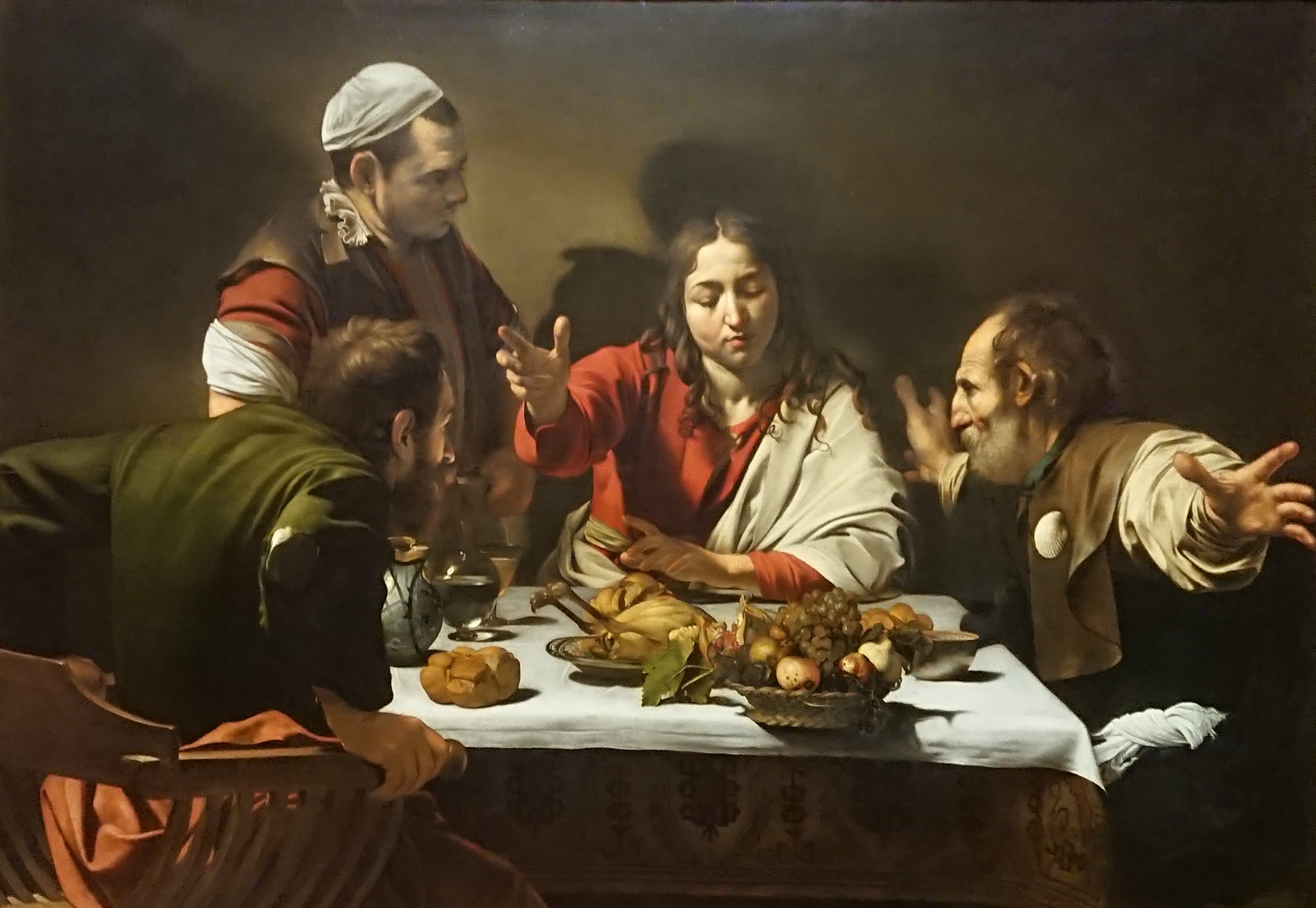
Caravaggio – his Emmaus painting – the servant

Emmaus: The Servant’s Story

There was something going on that day. The master and his friend had come in with this man they’d met on the road and I was serving them supper. Just the usual stuff – some bread, some wine, some cheese, some olives. I caught snatches of conversation and it was clear that something was going on, but I felt as if I was the only one in the room who didn’t get it. Ah well – I’m just the servant, the guy in the background, the guy with a job to do. Food to fetch. Pots to clear. Check everyone’s OK. Check everyone…

As I turned away, out of the corner of my eye, something changed in the appearance of the stranger and it looked like… well it looked like he was made of air, like a breath of wind would carry him away, like he could just vanish at any moment, but then when I looked again, he seemed more solid, somehow more physically present than anything else I’d ever seen.

He took the bread and said a prayer of thanks, as if this was his house, his table. But I thought, I know you’re a servant – it takes one to know one – and I noticed deep wounds in his hands and scars across his forehead and I thought, this man has suffered. Perhaps he’s a runaway slave, but there was nothing of the fugitive about him. He seemed more light and free and in possession of himself than anyone I’ve met. I thought, actually, I’m the one here who’s getting this. They’ve invited fire to supper, a whirlwind to the table, and they’re just asking stupid questions about scripture. But I guess it takes a servant to recognise a servant.

It was then that he looked up at me and I thought, those eyes have seen more pain and suffering than eyes should see. There were all the depths of ages in those eyes. It was as if they’d seen stars and planets born, but as he held my gaze it reminded me of when I’d looked into the eyes of my kids when they were babies, like his eyes were just starting to see the world for the first time, full of wonder and, as he held my gaze, full of trust.

Then he spoke to me and it was like the sound of rushing water, of roaring flames, of a storm wind ripping out trees and of sheer silence, all at the same time. But the words he said were, “Come. Join us.”

And right there I knew I had a choice that would change my life. I could say, “Thank you, Sir, but I’ve got work to do,” and pick up the empty pots, go back to the kitchen, keep my job and stay safe. Or I could pull up a chair and sit next to the hurricane, next to the fire, next to freedom itself and there’d be no going back.

I sat down at the table, with my heart in my mouth. He said, “This is the bread of life,” and gave me a piece. I knew it was the bread of Ben, because I’d bought it from him earlier, but when I tasted it, it was just amazing. You could serve this bread to angels and you’d blow them away. There is definitely something going on here, I thought. All my life I’ve given out, given out, served. Yet when this man served me, with only what I’d brought him, I felt filled up. I felt like I was caught up in a whirlwind, lifted up, soaring free. I was on fire. He was empty – there was nothing to him and yet all of creation, all of life was within him. He had everything. He had the world in his hands.

When they took the bread, the penny dropped for the others too and recognition lit up in their eyes. Then, all of a sudden, they started looking around, as if they couldn’t see him at all. “It was Jesus!”, said the master. “I knew it! Let’s get back to Jerusalem and tell the others.” But I could see Jesus was still there, wearing a smile as wide as the sky and holding his hands out to me. “Let’s go,” he said. “I know another way. Come with me.”

(© Alex Mabbs 2019)

Garden, Take 3

If you’ve been reading this blog for some time (thank you, thank you, always nice to see you), you may remember posts about my garden. If you’re new, or want to refresh your memory, try here or here or watch a slide-show with music here.

This is our third home since I got into gardening. That garden was enormous and I loved being out there. There was always something to do. The next garden was considerably smaller. I loved having much less grass to mow, and reduced the lawn further with a hedge and shrubs. This second garden was small but there was still enough to do to keep me interested, and enough seclusion to hide away and watch the birds in the leaves.

Now we barely have any garden at all. (I should maybe explain that the church provides the house, which is great in many ways, but we don’t get to choose, and I’ll keep the pension implications for another post in about 9 years time). This is a corner house, with a small concrete yard at the back and a strip of garden to the side and front. Or, as the front door is at the side of the house, should that read the front and the side? We still get confused, two years on.

I have struggled to come to terms with this garden, but I am starting to hatch some plans, which I will share with you…

That’s the front (side?) garden. It lies to the north of the house and gets very little sun. There’s a lovely rowan tree behind that bush, and a lovely fuchsia, looking like it’s had a very hard pruning, by the fence. Because of the shade, I don’t think there’s much to be done here, other than erecting a metre-high trellis to hide the compost bins, with something shade-loving (ivy?) growing up it. The gate leads through to the back (front? side?) garden.

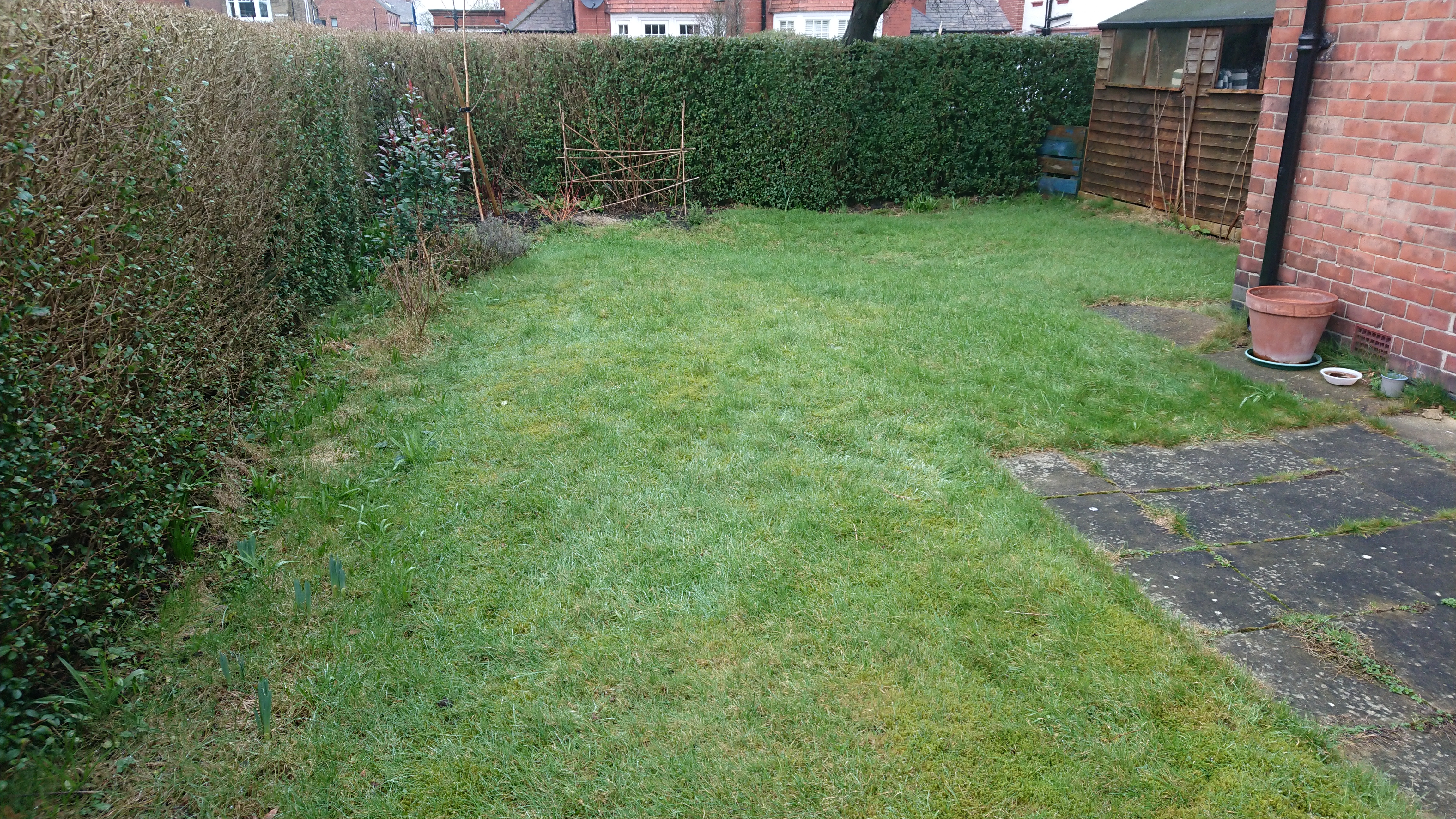
When we came, there was only grass apart from a very small (1X2m) vegetable bed in that back left hand corner (you’re looking north here). I extended the bed a bit and tried some veg, but the pigeons ate the brassicas, and other things just didn’t do very well. Last spring I extended the bed further along the hedge towards the south. I planted a Himalayan birch (silver birch is one of my favourite trees), with two dogwoods in front of it and a photinia to the side of it. The idea is that when I sit in my study, I can look out and see some winter colour against the green hedge. I put in raspberries, which seemed to do quite well, a blackcurrant bush, a forsythia, and some lavender for the bees.

I’d like to put in a pond somewhere near here. It will have to be very small, but I’m told it’s the best thing a gardener can do for wildlife. I’d also like to extend the planting, perhaps almost to the patio. I’d like more shrubs, probably fruit bushes. I think the trick with a small space is to go upwards. It will need some careful planning so that the plants to the south don’t shade those behind them.

This is the view looking south. There’s a rockery of sorts at the far end, with two fuchsias, some holly, a small acer tree, a self-seeded hawthorn that I’m encouraging, and a cupressus that I’m discouraging. I planted daffodils along the hedge because we love them. The first ones are just coming up. Mrs M started playing swingball during lockdown and developed an exercise routine based on it, so she needs enough open space beyond the patio to swing her ball, and that pretty much takes you to the hedge. She would like the patio extended but I’m reluctant. We’ll never match the existing slabs. Maybe gravel? A little Japanese-style planting somehow around the edge?

My aim is to have a garden that is pleasant to look at (and somewhere to play swingball), that provides shelter and food for wildlife (and a little for us), and that occupies me in my time off without being burdensome. I’ll keep you posted…

What do we want?

Another of my new year resolutions (well, it was made at the Greenbelt festival last August, but who’s counting?) is to get back into collective climate activism. What with Covid and moving to a different part of the country and taking on a demanding job and whatnot, I had dropped out.

I went to my first meeting of Climate Action Newcastle, and then a few weeks later went on a demonstration in the city centre. That’s me in the middle of the photo, in the red hat, looking cold and disorientated.

To be honest, I am sceptical about protests and demonstrations. I have been on many marches over the years and I am not convinced that they serve much purpose beyond the opportunity to express your anger or objection to something and communicate to the wider public that you’re not the only one who thinks like that. I don’t think they win many people over and I don’t think they persuade governments to change their minds. On 15th February 2003, I marched through London with an estimated 1.5 million others to protest against sending troops into Iraq. It was a massive ‘NO’, yet it was ignored by the government. The troops went to war, many died, and two years later the government was re-elected, which is the expression of opinion that really matters to politicians.

Anyway, there I was in Newcastle with about 200 others. First there was a rally where we stood in the cold and the rain and listened to people telling us stuff we already knew. Then we walked along the main shopping street chanting to the prompts of a man with a megaphone. There was also a samba band. I am getting old and these days I don’t like crowds very much and I don’t like loud noise. I wondered what we were achieving.

Well, people out shopping for Christmas that Saturday noticed that the climate crisis is important to a lot of people. I didn’t pick up any hostility towards us, which interested me when comparing to the olden days. Maybe most people understand that there is a problem. Perhaps they just haven’t connected the dots or given it much thought or simply don’t know what they can do about it. Another achievement was hearing an inspiring and encouraging speech from Jamie Driscoll, the regional mayor, who is using what power he has to address the crisis with practical action. Another was connecting up with friends from the north-east chapter of Christian Climate Action, as well as introducing myself to people campaigning for the Tyne and Wear pension fund to divest from fossil fuels – an area in which I have some experience to bring (and experience of some success in terms of church investments).

Maybe that’s the thing about activism. As with pastoral ministry, the important, basic thing is to be present. Be in the room. Be on the streets. See what emerges when you bring your passion and your person into the mix along with other persons and passions. As Roger Hallam, co-founder of Extinction Rebellion and Just Stop Oil, said in a recent radio interview, it’s not about success or achievement, it’s about telling the truth – “Say the truth and act as if it’s real.” We show up. We listen. We speak. We act. And the world changes when we do this together. The demonstration was a meeting place and the meeting is what mattered. And – for the first time in quite a while – I showed up. It’s a start.

Remember me?

Searching for an old photo yesterday, I found it on my blog. This blog, you know, the one I was going to start going again a couple of years ago and to which I haven’t added for, well, a couple of years. Oops.

What stopped me in the first place? My last job was about speaking to churches and groups about ecology, and it required a certain amount of self-promotion (probably much more than I was comfortable with) in order to build a profile & get the gigs. I changed what had been a wide-ranging personal blog into a more focussed website and I think I lost my creative mojo in the process. At the same time, I ventured into Twitter and more deeply into Facebook, and that lost me the impetus to write at greater length, or range more widely, on the blog. In the end I just lost the habit.

I came off Twitter after a year or two. It felt like a load of people in a room, all shouting at once. Not my kind of environment. I gave up on Facebook this last autumn. I became disillusioned because if I posted something silly or humorous, I’d get lots of engagement, but if I posted anything serious, it seemed that few people even saw it. I would scroll and scroll through adverts and the posts of a few friends but come away feeling drained of energy. I also got tired of reading so much hate and rudeness on posts about cycling or traffic. So I withdrew.

Searching for that old photo yesterday, I was reminded of some of the things I used to blog about - some serious, some less so – over a wide range of topics. I wonder if blogging is still a friendly medium, where serious ideas can be shared and where comments are broadly constructive and appreciative. If so, that feels quite attractive and I guess there’s one way to find out.

I guess there’s inevitably some conceit around this – that anyone will be interested in my reflections on life, which is basically what I’ll be posting. But I am increasingly convinced that the reason we are here is to help each other get through the dark night, and if my reflections on how I’m getting through help you now and then, and yours in turn encourage and inspire me, then that’s worth attempting.

So – here goes…

In the Tyre Tracks of Hadrian

It was a dry day off, if somewhat overcast. I cycled across the Town Moor, past the University, crossed a footbridge over the central motorway (whoever thought of a motorway through the centre of a city??), went down the Byker Link to pick up Hadrian’s Cycleway and head out to the coast at Tynemouth.

He may have been the Emperor of Rome, but – sadly – Hadrian never rode a bike. He did, however, build a big wall along the most northerly frontier of his empire. Hadrian’s Cycleway now runs, more or less, along the route of the wall. The wall ran across the width of Great Britain, from the Solway Firth in the west to the estuary of the Tyne in the east. It served two main purposes: defence against the Caledonian barbarians, and control of trade across the border with said valued trading partners.

Tyre tracks and train tracks

Centuries later, Newcastle was a power-house of trade and industry. This was coal country, and combine that with a sizeable estuary, and you have a recipe for prosperity. As well as coal, Newcastle was particularly known for ship-building.

And railways. The railway pioneer George Stephenson was born in Wylam, just to the west of Newcastle, and his son Robert at Willington Quay near Wallsend. Railways were vital in moving coal and other raw materials, as well as finished goods, from mines and factories to the docks.

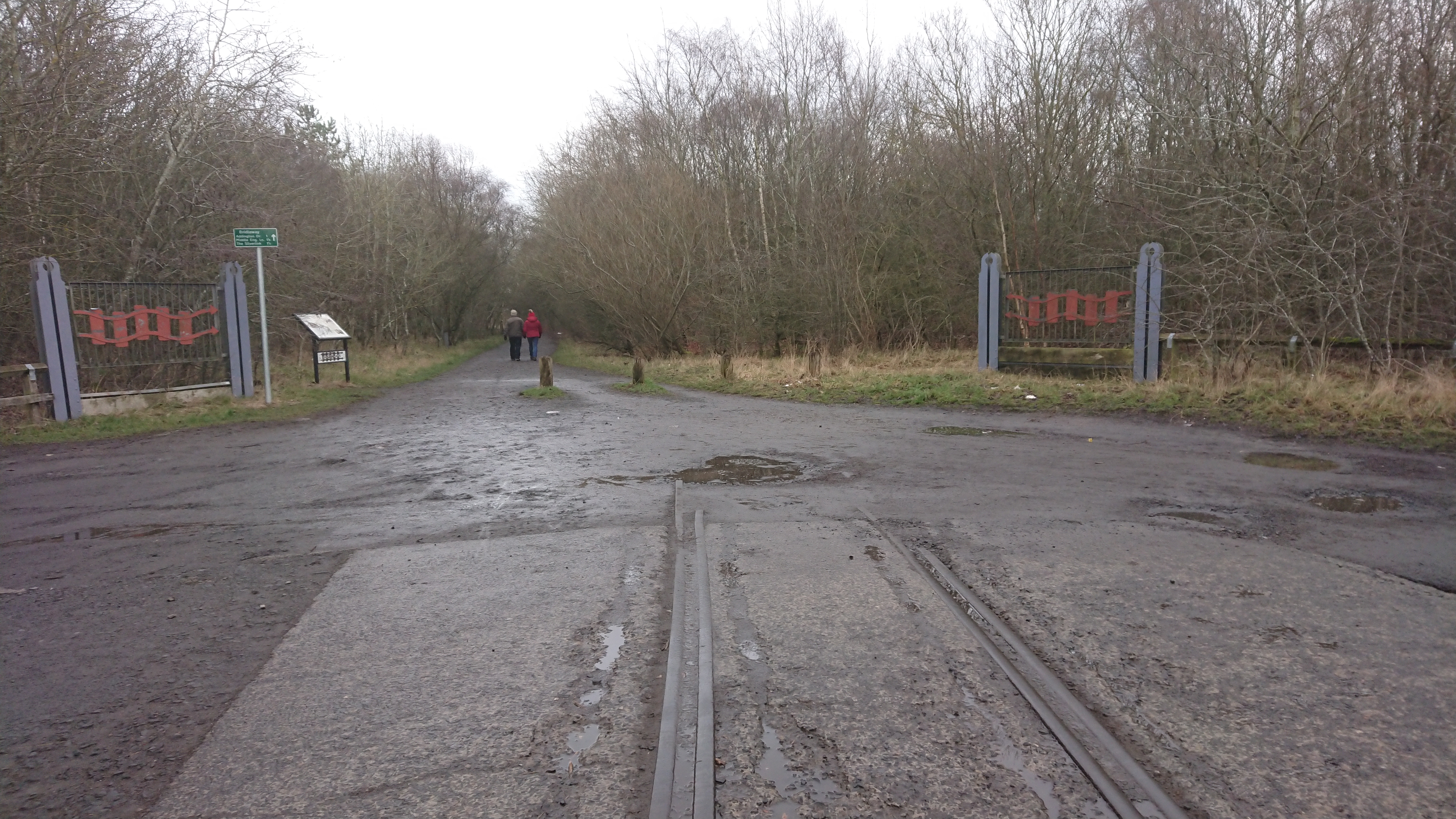
A branch line left the East Coast Mainline in Byker, and headed out east along the north bank of the river towards Percy Main. The first part is now a path called Byker Link. I joined it in the car park that has replaced Byker Station. Down near the river, the Link runs into Hadrian’s Cycleway, which now uses much of the old railway trackbed.

The whole route is still quite industrial, even though the shipyards and big engineering works have gone.

Riverside Crane

Wallsend is so named (surprise!) because this is where Hadrian’s Wall ended. There are Roman remains at the fort of Segedunum. Wallsend Metro station is reputedly the only railway station in the world to have bilingual signs in English and Latin.

I followed the coast out to Tynemouth, where there are the remains of a castle and a priory, and a still-intact chip shop.

Tynemouth Castle

Two wheels on my waggon

There is a network of Waggon Ways all over Newcastle. These were once railways running from the collieries (that were also all over the city) to the staiths on the river where the coal was loaded onto ships. Originally, the rails were wooden; later these were plated with iron and later still replaced with iron rails. Some of the waggon ways operated under gravity.

Over the past 20 years, many of the remaining waggon ways have been converted into tracks for cycling or walking. Using the waggon ways, I was able to cycle most of the way home off-road.

Alex’s cycleway

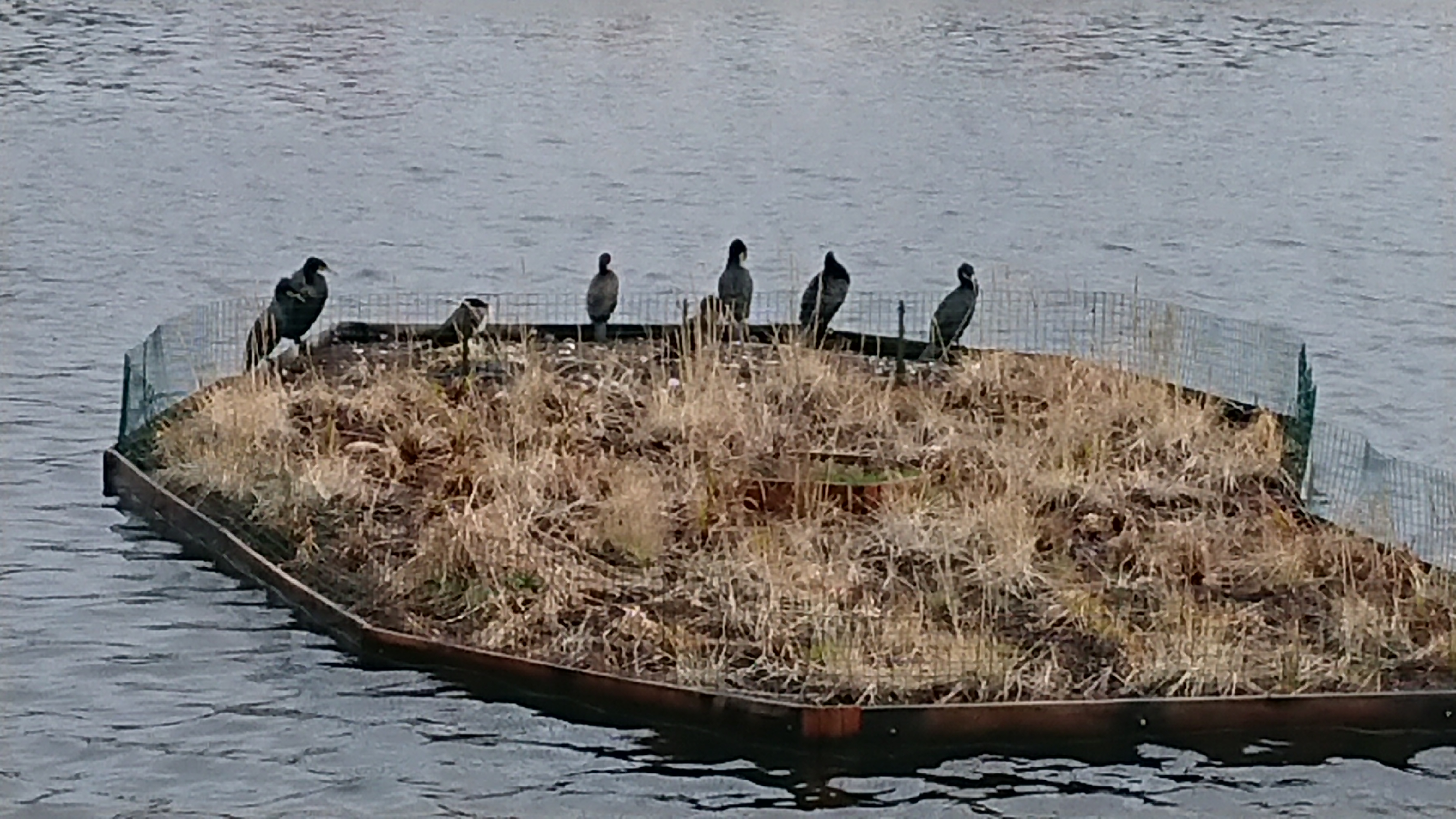
I feel sorry that Hadrian never rode a bike. I like riding my bike. I just enjoy being outdoors, but cycling puts a smile on my face and sometimes even makes me laugh out loud, especially when going downhill quite fast. I like the sense of achievement that I did this by the work of my legs, and that my journey was fuelled by toast and chips, not oil. I like the simplicity of the machinery, even with all these gears. I like the gyroscopic physics that keep me upright. I like the freedom of stopping when there’s something interesting to see, such as cormorants on an island in a marina. I like the sense of freedom generally.

So you can keep the Roman Empire. I’ll push that pedal, turn my chainwheel and be on my way.

My trusty steed enjoying the sea view

Go North

Mrs Mabbsnolongerbysea and I have moved 350 miles nearer the Arctic Circle. In August, we left behind the sun, the sea and the sand (well, the pebbles) of Brighton and Hove, after living there for 15 years. We now live in Newcastle Upon Tyne. I’ve taken up a new post as ministry team leader at Trinity Church in Gosforth, a suburb to the north of the city centre.

Newcastle is not Brighton. I have yet to find a nice little local shop selling organic porridge oats, for example. I miss having the sea at the end of the road and the Downs nearby. We’ve been so busy sorting out the house that I haven’t yet done much exploring of what I know to be the beautiful and spacious Northumbrian countryside and the wide empty beaches. I’ve haven’t even ventured into the wonderful city centre more than a few times.

One of my New Year resolutions, then, is to get on my bike and explore. I need to put down new roots and learn how to be me in this new place.

Another is to get into this blog again. One of the things that’s been putting me off has been a sense of lack of focus. I’m sure blogs are supposed to have a Big Idea. But is it OK if I continue to write about life? If I write about spirituality, cycling, music, faith, ecology – whatever – will you be interested? I guess there’s one way to find out…

Being a Good Ancestor

These are uncertain times. The COVID pandemic and the climate crisis are dismantling the life we’ve known and the bridge back to normality is on fire. I wonder if November’s autumnal mood of remembering those who have gone before us might give us courage to walk into the darkness that lies ahead. Can our ancestors help us, in our turn today, to be good ancestors?

Remembrance

November gives us All Saints Day, then All Souls Day. Then there’s Remembrance Sunday. “We will remember them,” we intone, as we honour our war dead. Then, at the end of the month, some of us mark the Remembrance Day for Lost Species. We mourn the animals and plants that have been lost to the earth – to us – in this present mass extinction.

Meanwhile, all around us (at this northern latitude, anyway), the leaves are falling from the trees, the daylight is retreating, and there’s a melancholic mood in the damp air.

Today, England has gone into a second lock-down in response to a sharp rise in COVID cases. In the summer we thought we were coming out of it, but here we go again. How many more of these will we have? Will I ever get my old life back?

The answer is increasingly looking like, “No.” It looks, increasingly, as if we’re going to have to learn to live with this virus – and perhaps others that will cross to humans from the beleaguered and diminished wild.

The leaves fall on the graves of the dead. Earth to earth. Death to death. Autumn’s melancholy is ripe for nostalgic remembrance.

Fore-bearance

In church we marked All Saints Day. We looked at that passage in Hebrews chapter 11, of the ‘hall of fame’ of heroes of faith. The book of Hebrews draws on earlier biblical traditions of remembering inspirational people from the past, with that idea that God helped them so God will help us.

But Hebrews twists the tradition. The emphasis is not so much on God-given gains but on loss. The writer tells of Abraham, Isaac and Jacob, making the point that they didn’t see the fulfilment of what God had promised them. The same goes for Moses. Then the writer moves on, almost seamlessly, from famous biblical characters to un-named martyrs, possibly martyrs known to that particular church community.

The point is not to look back but to look forward. That’s what the ancestors teach us, says the writer of the book. Their faith was not primarily for themselves but for those who would follow after. “They would not, without us, be made perfect.” (Hebrews 11.40).

The saints in glory are not demanding our attention – if anything, they are giving us theirs. They know that their sacrifices are only meaningful if those coming after them build on their foundation so that the better world for which they longed becomes reality.

A good ancestor is one who looked ahead so that those who followed after could have a better future.

Can I be a good ancestor?

This is the subject of Roman Krznaric’s latest book (you can see his 7-minute TED talk here: https://www.ted.com/talks/roman_krznaric_how_to_be_a_good_ancestor#t-1482). I think it’s a fascinating idea. He says that industrialised societies have colonised the future. Our extractive and wasteful way of life is devastating future generations in a similar way that European empires devastated their colonies in other continents. Those future generations, though, are powerless to rebel or resist because they don’t yet exist.

Krznaric contrasts a growing movement to decolonise the future. He relates the way that seven-generation decision-making practices of indigenous Americans are influencing Future Design workshops in Japan. What if every decision – whether in business, government, or whatever – had to consider the impact on the seventh generation to come?

Become a time rebel! Learn to think long-term and be a good ancestor.

Since 2015, the Well-being of Future Generations (Wales) Act has put good ancestry into law. The well-being of the unborn is embedded into the Welsh government’s decision-making, with a ‘future generations commissioner’ to hold the government to account.

Holding the future in open arms

Going back to the bible, I think of a story in chapter 2 of Luke’s gospel. Simeon and Anna are elderly and devout, spending much of their time in the temple in Jerusalem. Simeon believes that he will not die until he sees the Messiah. In come Mary and Joseph to dedicate their 40-day-old baby to God. Simeon takes baby Jesus in his ancient arms and Anna joins him in praising God.

Simeon and Anna didn’t see that baby grow up. They didn’t hear the parables or see the miracles. They didn’t see him fulfil his destiny. Their faith in a baby held a door open for him into a future they could not and did not themselves enter.

I want to learn to be more mindful of the impact of my life on the well-being of future generations, including generations of my direct descendants. Perhaps if I could hold that future in open arms, the love that acts for good but lets the beloved be free might replace my fear with hope and courage.

As I hold in my ageing arms a future I cannot determine, I myself am held in arms immeasurably ancient. And so I go out into the darkness. “Put your hand into the hand of God. That shall be to you better than light and safer than a known way.” (Minnie Louise Haskins)

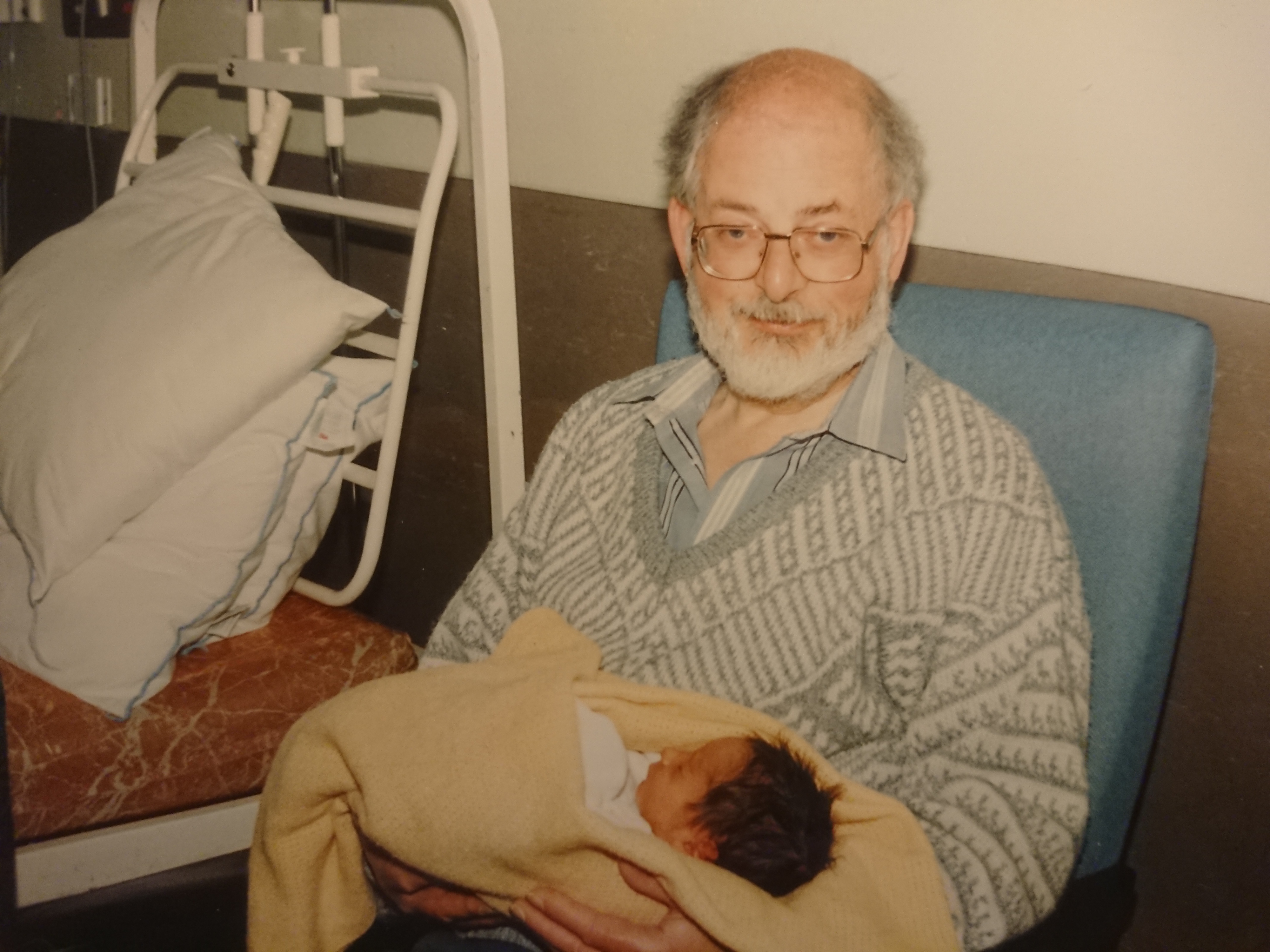
My father-in-law holding his first grandchild, then one day old. Tony died when Zac was 14 and didn’t see him grow up to follow in his footsteps as a highways engineer. But as he did with his own children, Tony would have encouraged Zac, above all, to follow his dreams and be himself. A good ancestor.

Songs of Zion in Covid Babylon

I’ve been in quarantine for nearly two weeks and I am going stir crazy. I am longing to be able to go for a walk or a cycle ride again and venture beyond our front garden wall. I am telling myself: Friday. Even if it’s raining, on Friday I will go out.

But underlying this is a growing sense that the end of the wider coronavirus restrictions may never come. I find myself daydreaming about holidays, or what I might do in church, or at Christmas. Then I come back to reality, because I wonder if the life I’ve known will ever be possible again.

This is how I feel:

By the rivers of Babylon –
there we sat down and there we wept
when we remembered Zion.
On the willows there
we hung up our harps.
For there our captors
asked us for songs,
and our tormentors asked for mirth,
saying,
‘Sing us one of the songs of Zion!’

How could we sing the LORD’s song
in a foreign land?
If I forget you, O Jerusalem,
let my right hand wither!
Let my tongue cling to the roof of my mouth
if I do not remember you,
if I do not set Jerusalem
above my highest joy.

(Then it gets quite nasty, which is for another day’s comment.)

Psalm 137.1-6

For the Jews in exile 2500 years ago, thousands of miles away from home in Babylon, I wonder if they felt a similar sense of despair. There were prophets like Hananiah, who foretold that the exile would only last two years before God broke the yoke of the Babylonians (Jeremiah 28). Jeremiah, on the other hand, was a doomsayer, rejecting any sunny optimism.

Or was he? He encouraged the exiles to make the most of their time in exile – that in the flourishing of Babylon would be their flourishing. He foretold it would be 70 years before they might return home.

In fact, many of the dispersed Jews never returned to Jerusalem. For those who did, and for those who didn’t, life would never be the same as it had been before the Babylonian conquest.

I am finding it very hard to believe that my life will ever be the same as it was before the virus hit. I feel something of the anger that the nasty end of the psalm expresses, however silly it may be to be angry with a little blob of protein.

I also feel something of the nostalgia expressed in the psalm. Ah – those happy days of travelling by train; of singing in a crowd; of meeting up with family and friends; of coffee and cake, of events and Interesting Things To Do.

Jerusalem was (is!) a real place. The psalmist resolves never to forget it. Their longing for the end of exile is rooted in a real place. It’s not abstract.

Zion, on the other hand, is ambiguous. It can sometimes be a synonym for Jerusalem, but at other times it means a kind of idealised, maybe utopian, homeland-to-come. For example, when Bob Marley sang about Zion, he wasn’t thinking about the city of Jerusalem itself.

For the exile with hope, home is not where you’ve come from but where you’re going.

The songs of Zion could be songs about the world to come, not the world that used to be.  But because Zion has this ambiguity about it, our hope is rooted in reality. It shouldn’t be spiritualised.

The challenge of the psalm, perhaps, is not to hang up our harps in sad despair, but to bring our anger and our nostalgia into the light and learn how to sing of the world to come, while still in this strange, foreign land of exile.

So perhaps I am asking the wrong question in my frustration, nostalgia and anger. Rather than try to figure out how I can do the things I used to do but within the ever-changing restrictions of the pandemic, perhaps the question should go forwards: What kind of world do I hope for? What will be important in the world I hope for? And then: How can I practise what I hope for while still in this strange land?

It’s not about how I can live when I get back to Jerusalem, but how do I live here and now, and flourish here and now in what is important to me?

Can this kind of exilic Zion thinking be applied to society? At the moment, the narrative is about propping up enough of the life we knew so that we can survive this exile until the old life can be restored – in the travel industry, the hospitality sector, university education, church services and community projects and just about everything else.

What if we were able to think together about what we want from the world and truly build a new normal, one that’s more like the world we want, here in the exile that no one wanted but that’s where we are for the foreseeable future? What if we could do this and make sure that justice for those who are most vulnerable is at the forefront of our concerns?

What if we could figure out how to sing songs of Zion in Babylon?

I doubt it will happen. It took the Jewish people centuries to transition from a pre-exilic, temple-based culture, and I’m naïve if I think our culture will change itself in a matter of months.

But I can change. I can change my outlook from anger and nostalgia to hope.

At least, I can try…

The Messenger Is The Message

Extinction Rebellion (XR) is on the streets in London, Manchester and Cardiff this week. In the news: Protesters arrested. Protesters urged to reconsider actions because of COVID-19. Literary figures join the campaign. Police put on a show of strength. XR blocks roads.

XR tweeted this complaint: We are not the story. The story is catastrophic government failure to act on the climate emergency.

The problem is, that’s not as interesting as a load of people blocking roads, waving flags, shouting, getting too close to each other, and being arrested.

People make good stories. People are interesting. What they have to say is usually not so interesting.

The challenge is, then, if you’ve got something very important to say, how do you get it into the news? How do you get others to join you? How do you get the government to change its policy, especially one that seems to take little seriously and that’s so riven through with vested interests? The conventional wisdom behind demonstrations and protests has always been to make a big fuss, disrupting and obstructing the normal business of a city centre. The story is that we’re making this big fuss because the point we want to make is really important, perhaps so important that we’re willing to make some personal sacrifices for it, like getting arrested.

And that is the problem. The story is the fuss, not the message.

The messenger is the message, like it or not.

There is a story worth telling here. Business as usual is being disrupted by global heating and the disruption will only get worse. Our lives are on the line. We are all going to be arrested to some degree or other in the sense that our present way of life is going to come to a stop. At the same time, the mutual support and respect that’s expressed within XR and their commitment to non-violence embodies something of a world of care and gentleness that could emerge from the coming collapse of this world. You could say that XR is being prophetic, not so much in what they say as in what they do.

If no one listens or understands, that was always the fate of the prophets. The word is like fire in the bones, according to Jeremiah (20.9) – impossible to hold in.

The messenger is the message, so live it out loud!

Fire Bird

What flashed through my mind as I fell was the image of a bird, plummeting down from the sun, its feathers like fire, with all the colours of the rainbow in those flames as it soared through the sky.

When I came to, the world had gone black. I could feel hundreds of legs and proboscises all over me. Quick as I could, I jumped up and immediately collapsed in a flash of pain. My left leg! I had to get the bugs off me, so standing on my right leg, I shook and brushed with my hand as the pain hit me again and again. I had to get them off me.

I had to get me off the ground. Hauling myself up onto the lowest branch, swinging my good leg up, I ripped off my top and shook it out. Boots next. Lucky the laces rotted away months ago. A good shake of my trouser legs would have to do. Too much pain. Rummaging for my knife in my pocket, I got a purchase on whatever was burrowing into my arm and hooked it out. I wanted to lick the wound but it was too risky. I rolled up my shirt and wrapped my arm as tightly as I could. The smell of blood was almost as dangerous as the smell of carbon dioxide. I was being eaten alive as it was.

I had to move higher up. If I was lucky I might make it back to my pack, which if I was lucky was where I’d left it so suddenly, way up there. I needed water, salt and my insect net or I might not last till morning.

My leg hurt like hell and I felt dizzy but up I went, feeling my way in the dark. My injured leg slowed me, but so did the fear of a branch breaking if I was too quick. Everything was so eaten away these days. Also, the tree was covered in wet moss and I knew if I slipped again that might be the end. It seemed so much further this time, but at last my groping hand brushed against the canvas of my pack where it rested against the trunk.

First things first. There was the insect net. It was like a tent that went all around me and zipped up. I always seemed to trap a few things inside, but it kept the worst at bay. There was my water bottle. I took a good swig. There was the little jar of salt. I unwrapped my arm and sprinkled salt until I felt it sting. There was the last shirt I possessed. On it went, as did the top half of the protective overalls I’d stolen earlier.

I leaned back against the trunk, my left leg along the narrow branch and my right dangling. I had thought I’d tie myself to the trunk to stop myself falling in my sleep, but once in place, I realised that I hadn’t figured out how I could do that and be inside the net. But I was in so much pain with my leg and my arm that sleep was unlikely anyway.

So there I sat and mulled it all over. This hadn’t been my plan at all. The plan had been to raid the Residence and get back to our settlement and that be that.

Han, spying the day before, had spotted that the little red light on a camera overlooking one of their food-growing domes was no longer blinking. Perhaps water had got in and damaged it. We were surprised they hadn’t fixed it, but perhaps they needed to get a part sent over from another Residence. Time was of the essence, so that night we struck.

The Residences were like networks of linked geodesic domes, built by the wealthy as it became clear that things were going very badly – food scarcity, social collapse, weather.

At first the domes were only used to grow food, now that there was less direct sunlight and a lot more rain. They were made of toughened polycarbonate and fortified with a high fence. They were self-sufficient with power from wind turbines and systems for collecting and purifying rain water. The wealthy kept adding to them until they were the size of small towns.

As the large towns and cities became uninhabitable, being too near rivers or the sea, the wealthy moved into the Residences.

In the early days, Outsiders, living nearby in houses, worked in the Residences as domestic servants or in the horticulture domes. But after the birds disappeared and the insect population bounced back with a vengeance and the warm and wet climate grew warmer and wetter, we grew sicker and the Insiders shut us out and did the work themselves.

There were battles then, and many of us died. They had guns and we had sticks. But they had food and medicine and dryness and we had none of those things.

We could forage but it was a poor diet and the knowledge our grandparents might have had about which plants and bugs were edible and which were poisonous had been forgotten, so we had to use trial and error and yet more of us died while we learned.

So when we saw a chance to raid the nearby Residence, it was a chance we had to take.

We got over the fence OK and then, placing the sharpened point of a big flint against the edge of a low pane of polycarbonate and striking it with a much bigger rock, we broke in.

The food was good. Modified for maximum nutrition, I could feel its energy as I swallowed. I stashed as many leaves as I could into my pack. Sol found a box of weather-proof protective suits and we had those too, one each. My raincoat had stopped being waterproof a long time ago. This was great.

But then they came.

The door crashed open and I dived to the ground behind a plant bed. Quick as I could, I wriggled out of the broken panel while the bullets flew. I stayed low but fast. When I reached the fence, I skirted around until I was away from that dome. Then with one good jump and a clamber I was out.

I had no idea where I was going. Nights are usually dark these days. Sometimes the clouds show a little lighter where they’re hiding the moon, but tonight the new moon was only a day old.

I knew there was no point going back to the settlement. The Insiders were certain to seek retribution, even if everyone was lying dead in that horticulture dome at the Residence.

Everyone but me.

I kept up a good pace all through the night. When the sky started to lighten ahead of me, it was a relief.

After a few hours of daylight, I saw some old houses and made my way over. They were in poor shape. It doesn’t rain all the time, not quite, but when it’s not raining the air is still damp and everything rots. Any structural timber that the insects haven’t eaten rots away. Structural steel rusts. Bricks crumble. The things that survive best are aluminium window frames and doors.

One of the houses had a lean-to at one side that was fairly intact. It had a solid, tiled floor and some chairs that looked like they were made of woven plastic. I had a quick look around but there were no signs of recent human activity. I sat on the long chair, got into my net, lay down and was asleep straight away.

A sharp pain in my foot woke me. I jumped up and saw a rat run off. I had a look and there was a bite out of my big toe. I used a little water to wash it and dabbed a little salt on it. I should have kept my boots on. I knocked the bugs out of them, put them on, packed up my net and set off again.

Over the hill, to my left was an expanse of water, several kilometres wide. That would be the Trent, I guessed. From Derby (or where Derby now lay submerged) to where it ran into the sea near Gainsborough, the river was more like a lake. I turned away from it and headed in what I presumed was an easterly direction.

By twilight I was in the wood. That’s a rather romantic description. Most trees had fallen prey to a combination of insect damage and diseases carried by the insects. Mostly the ‘wood’ consisted of the rotting, diseased remains of trees, some still half-alive, surrounded by ferns, sedges and the horse-tails that seemed to be taking over everywhere. But here and there stood trees that seemed to be resistant to the insects.

I found one that looked sturdy enough to hold me. It was tall, but the lowest branch was at waist height. A good climbing tree, even though it was covered in thick moss. Willow? Poplar? I don’t know – as I said, it was my Grandparents who turned their backs on nature.

The ground was seething with all sorts of creeping things and to rest on the ground, even standing, wasn’t an option. So up I climbed and, as you know, down I fell. And up I climbed again and kept vigil with my searingly painful leg through the long night.

As soon as it was light enough to see, I did some careful stretching, extracted myself from my net, shouldered my pack and started lowering myself towards the ground. It still hurt to use my left leg, but I could put some weight on it, so there was hope.

At the foot of the tree, I hobbled across to a sapling of something and cut around it with my knife until I could snap it off. I trimmed it to about two-and-a-half metres, and then cut a length of that to match against my left leg. I tore my bloodied shirt into strips and lashed the pole to my leg. With the other pole in my right hand, I limped off towards the sea.

It was slow going. Partly it was my leg, and partly the soft ground, which tried to swallow my walking stick every time I put it down.

About half-way through the afternoon I could smell the sea. It was revolting. I had been told about the rafts of decaying fish and other marine creatures that floated around on the surface of the sea, but it had to be smelled to be believed. However, the advantage of that, I had also been told, was that all that rotting flesh drew flies away from the land. In any case, there were fewer insects that could tolerate the salt in the marshes, compared with inland. Also, I could now see the other thing that had attracted me to head this way when my old life in the settlement got shot to pieces.

It was a collection of large buildings made of glass panels set in aluminium frames, a bit like the Residences but basically cuboid. All around this part of Lincolnshire, when the sea started to wash over what had been the most productive arable land in the country, farmers turned to farming insects.

It was the first Great Food Crisis and insects were seen as a good source of protein and calories, and farming them required few costly inputs. Starting with crickets, locusts and buffalo worms, this was going to be the future. If people hadn’t been starving, it might not have caught on, but for a while it was a booming industry and glass-houses like these went up all over the place, breeding an increasing range of edible insects, many of them imported exotic species.

But the cities flooded, weather changed, society collapsed into anarchy, the Insiders retreated to the Residences, and many Outsiders didn’t survive for long. The insect farms were abandoned to the storms and the floods, and the insects escaped and colonized the land left vacant by the first round of extinctions. But now, here, was somewhere I might be able to live.

I chose the house with the most intact panels. Cannibalising the other houses to repair it would give me something to do after my leg healed. But in the meantime, I would be alright with my net.

Growing around the marsh was kale, purslane and samphire. The sea itself was probably too poisonous, but there was more than enough insect life, even here, to supplement the plants in my diet. I’d get used to the smell of the sea.

My first job would be to rig up some rain-water collection, which I would do in the morning. I just about had enough left in my bottle for tonight. I also had the last of the stolen leaves. I would be OK.

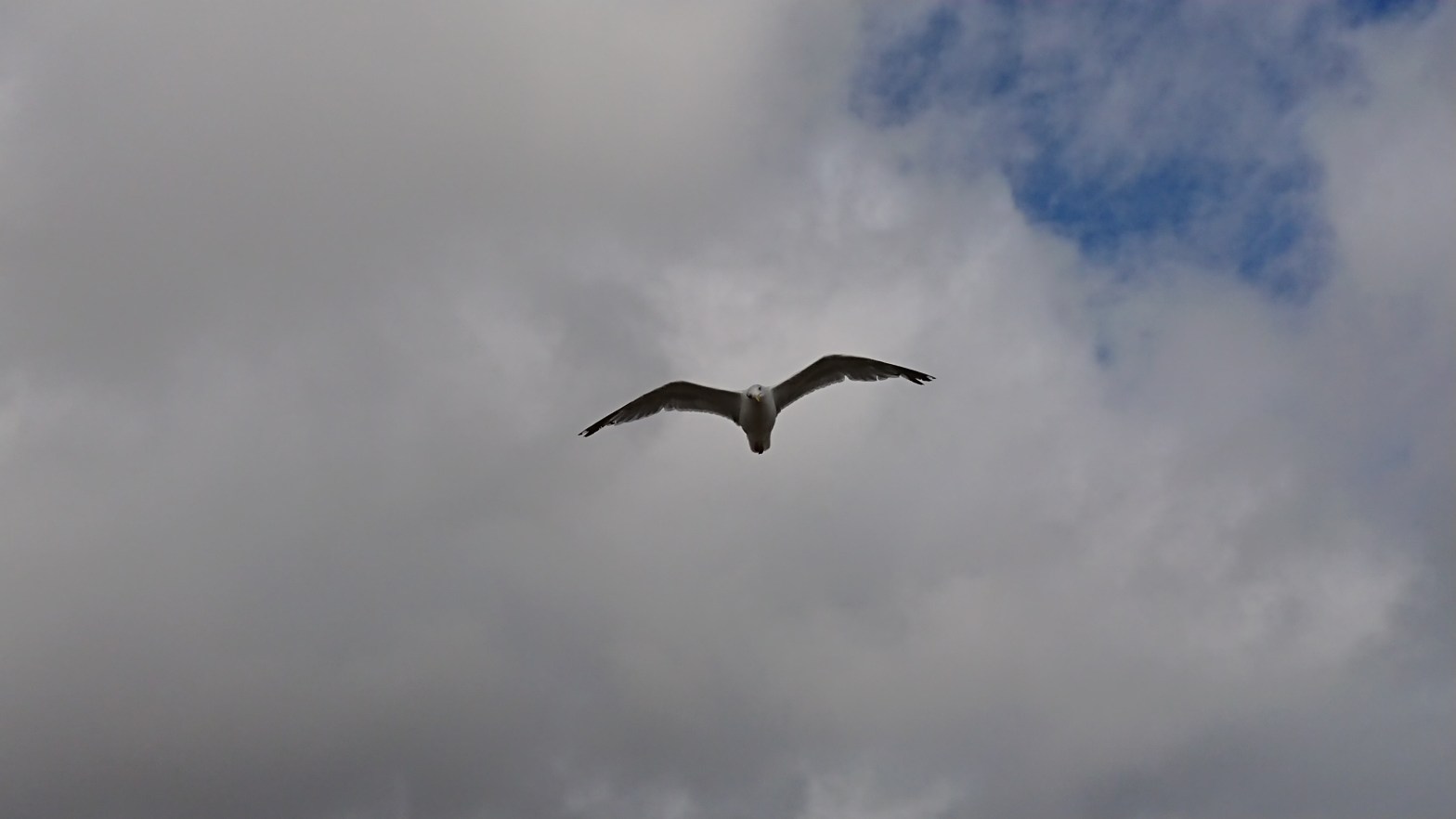
Early the next morning, I stood outside looking over the marsh, and there it was. I had never seen a bird before in my life, but there it was. It looked so clean: white and grey, with dark tips on its long, outstretched wings, gliding past me with unimaginable grace, in no hurry at all. A gap opened in the cloud near the horizon and a shaft of sunrise lit the bird as if it were aflame. I hadn’t thought there could be such raw freedom and beauty in the world. It was incredible. The breath stopped in my throat and a fire of joy leapt inside me.

I’m alive. I am going to be OK.